Cheshire Henbury's website is structured around several sub-sites to accommodate the large amount of content. Please pick a topic of interest from the above menu and begin to explore and learn. Or use the Google Search box to the left.
Agile Manufacturing: Forging New Frontiers |
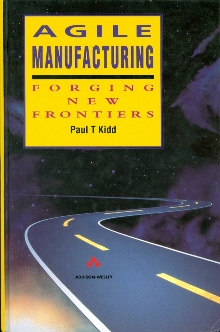 |
Agile Manufacturing
Paul T Kidd
ISBN 0-201-63163-6 (Hardbound)
Publisher: Addison Wesley
Price: See buy on-line link
Publication Date: June 1994
|
-
-
|
-
Agile Manufacturing: Forging New Frontiers
Chapter 9 Introduction
-
In Chapter 4 we examined and highlighted
the problems associated with our traditional management accounting
paradigm. There are a number of important difficulties and methodological
issues that have arisen in relation to our traditional management
accounting methods, which we will need to address and resolve
in Agile Manufacturing environments. These are:
1. Our investment decisions have been traditionally
taken based only on financial appraisal;
2. The aim of most of our investments has
been to reduce costs. Technologies tend to be justified using
cost reduction even when the goal is increased flexibility or
quality;
3. Our traditional management accounting
methods encourage a cost driven approach in manufacturing and
support the view that our people are a cost rather than an asset;
4. Overhead allocation based on the amount
of productive capacity used in the manufacture of a product is
often an inappropriate way to allocate overheads, especially
when a significant amount of customised work is mixed in with
standard work;
5. Our traditional management accounting
methods do not highlight the true cost drivers in our enterprises;
6. The emphasis of our traditional management
accounting methods is on financial performance measurement and
control systems which can lead us to make erroneous conclusions
about performance;
7. There are difficulties in justifying investments
in FMS and CIM because these technologies lead to revenue generation
which is difficult to quantify, and because the full benefits
may not be realised until sometime after implementation.
The traditional management accounting and
investment appraisal methods that we use today, are inadequate
for dealing with the complexities of Agile Manufacturing. New
methods, such as activity based costing, are being implemented
by our manufacturing businesses, but there are a number of issues
that need to be addressed. Our purpose in this chapter, is to
consider these issues and to form the outline framework of a management
accounting system suitable for Agile Manufacturing environments.
We start by examining these issues.
|
Legal Notice: The information posted on the web site
is designed to provide accurate and authoritative information
in regard to the subject matter covered. Every effort has been
made to ensure the accuracy of the information contained in the
web site. The information is believed to be correct at the time
of publication. Cheshire Henbury cannot however accept any responsibility
for the completeness, accuracy and relevance of the information.
Information is published with the understanding that publication
does not represent the rendering of advice, consulting or other
professional services. Specific application in a particular organisation
is the sole responsibility of the representatives of that organisation.
If expert advice is needed, the services of a competent person
should be sought. Please read our terms and conditions (opens in a new window) for use of this web
site.